vrijdag 17 februari 2012

'Horror frog' breaks own bones to produce claws


"Amphibian horror" isn't a movie genre, but on this evidence perhaps it should be. Harvard biologists have described a bizarre, hairy frog with cat-like extendable claws.
Trichobatrachus robustus actively breaks its own bones to produce claws that puncture their way out of the frog's toe pads, probably when it is threatened.
David Blackburn and colleagues at Harvard University's Museum of Comparative Zoology, think the gruesome behaviour is a defence mechanism.
The researchers say there are salamanders that force their ribs through their skin to produce protective barbs on demand, but nothing quite like this mechanism has been seen before.
The feature is also found in nine of the 11 frogs belonging to the Astylosternus genus, most of which live in Cameroon.


Male Hairy Frogs grow threads of vascularised skin during mating season
(Image: Gustavocarra / Creative Commons License)

Instant weapon

"Some other frogs have bony spines that project from their wrist, but in those species it appears that the bones grow through the skin rather than pierce it when needed for defence," says Blackburn.
At rest, the claws of T. robustus, found on the hind feet only, are nestled inside a mass of connective tissue. A chunk of collagen forms a bond between the claw's sharp point and a small piece of bone at the tip of the frog's toe.

The other end of the claw is connected to a muscle. Blackburn and his colleagues believe that when the animal is attacked, it contracts this muscle, which pulls the claw downwards. The sharp point then breaks away from the bony tip and cuts through the toe pad, emerging on the underside.


The claw breaks away from a small piece of bone (see arrow) at the tip of the frog's toe
(Image: Blackburn)


Hirsute horror

The end result may look like a cat's claw, but the breaking and cutting mechanism is very different and unique among vertebrates. Also unique is the fact that the claw is just bone and does not have an outer coating of keratin like other claws do.
Because Blackburn has only studied dead specimens, he says he does not know what happens when the claw retracts - or even how it retracts. It does not appear to have a muscle to pull it back inside so the team think it may passively slide back into the toe pad when its muscle relaxes.
"Being amphibians, it would not be surprising if some parts of the wound heal and the tissue is regenerated," says Blackburn.
Males of the species, which grows to about 11 centimetres, also produce long hair-like strands of skin and arteries when they breed (see image). It is thought that the "hairs" allow them to take in more oxygen through their skin while they take care of their brood.


The sharp bony claws look like small barbs
(Image: Blackburn)


Spiky snack

In Cameroon, they are roasted and eaten. Hunters use long spears and machetes to kill the frogs, apparently to avoid being hurt by their claws.
"This is an incredible story," says Ian Stephen, curator of herpetology at the Zoological Society of London, UK. "Some frogs grow spines on their thumbs during breeding season, but this is entirely different."
"For me, it highlights the need for a lot more research on amphibians especially in light of the threat of mass extinctions," he adds.
The existence of frogs with erectile claws like cats was first described by Belgian zoologist George Boulenger in 1900 in frogs found in the French Congo, now the Republic of Congo.

woensdag 15 februari 2012

Smallest chamaeleon in the world


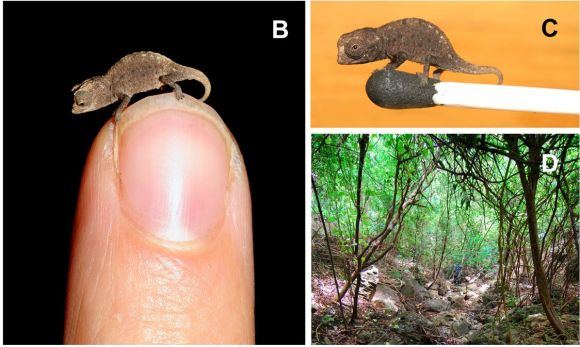
Scientists have discovered a new species of chameleon, Brookesia micra, believed to be the smallest in the world.

Brookesia micra chameleons live in the remote forests of Madagascar.
The juveniles are small enough to fit on the head of a match.
(Glaw, F., et al., PLoS ONE/Courtesy)
 
The tiny lizard, native to Madagascar, measures less than 30 millimeters fully grown – and when young, it is small enough to stand comfortably on the head of a match.
It was found by a team of German and American scientists, who described their discovery in the PLoS ONE journal.
The miniature chameleon lives on the forest floor by day and crawls into low branches to sleep at night, they say, which is when the researchers spotted it. Dr Frank Glaw of the Bavarian State Collection of Zoology, who led the expedition, told the BBC he and his colleagues scoured the forest at nightime during the wet season, using torches and headlamps to spot the rare lizards as they roosted.
They were seen only in one remote islet in Madagascar's uninhabited Nosy Hara archipelago, which the scientists suggest provide the explanation for their small size. In a phenomenon known as island dwarfism, species confined to islands commonly evolve into minature versions of their mainland cousins, according to Wired, possibly due to limited resources and pressure to reproduce faster.
The specifity of their habitat also means that the species is extremely vulnerable to extinction if the forests it lives in are threatened, Glaw warns.
Brookesia micra is one of four new species of chameleon they documented on their expedition to Madagascar, which according to The Local is home to nearly half of the world's 193 known species of the reptile.
The country is known for its many rare species of giants – including giant lemurs and tortoises – as well as dwarfs, such as the world's smallest primate, the mouse lemur, and some of the tiniest known frogs.
Brookesia micra, too, shares the island with the world's largest chameleons, which can grow to almost 70 centimeters long.

zondag 12 februari 2012

Puerto Rico killing iguanas to export meat


SAN JUAN, Puerto Rico — Iguanas of Puerto Rico: Your days are numbered.
The island's government is announcing plans to kill as many of the reptiles as possible and export their meat in hopes of eradicating an imported species that has long vexed residents and entertained tourists.
The U.S. Caribbean territory has roughly 4 million iguanas, which is a little more than the island's human population, according to Daniel Galan Kercado, secretary of the Department of Natural Resources.
"This is a very big problem. We have to attack it," he said in an interview Friday. "It has impacted structures, the economy, crops and the ecosystem."

An Iguana sits on the fourth hole of a golf course
in Puerto Rico, where roughly


Puerto Rico has long struggled to eradicate the bright green reptiles that can grow up to 6 feet (1.8 meters) long and have a life span of some 20 years. Iguanas are considered an endangered species throughout most of Latin America, but Puerto Rico is overrun with them, in part because they breed so quickly and have few natural predators.
The reptiles were first seen in the wild in Puerto Rico in the 1970s when owners began to release them, and their numbers have since exploded. They have been blamed for taking over airport runways, burrowing under buildings and destroying foundations, and causing blackouts by building nests near the warmth of electric plants.
Galan and other government officials, including Gov. Luis Fortuno, said killing the iguanas for export is a novel solution that economically benefits an island in its fifth year of recession.
Puerto Rico's Department of Health has approved letting Galan's agency finalize a plan to train volunteers to capture live iguanas and bring them to a processing center for slaughter and distribution to the U.S.
Demand for iguana meat is high in U.S. states with large populations of Latino and Asian immigrants, said Galan, who anticipates having the plan finalized by May. It would then have to be reviewed by several government agencies before it's approved.
Galan said numerous people have contacted his department to participate in the iguana roundup, although officials are still looking for a company that would help process and export the meat, which can be sold for up to $6 a pound.
"That is a lot more than chicken," he said. "It has great economic potential."
Fortuno said at a press conference this week that he supports the proposal.

maandag 30 januari 2012

Amphibian Lab is Coming

 
January 29, 2012
By
The Smithsonian Tropical Institute will open a new Summit Park Amphibian Rescue Center in Panama.
The laboratory’s mission is to prevent the extinction of a number of species including the endangered golden frog, Panama’s national animal. Since 1980 more than 120 species of amphibians have gone extinct, under assault from the rapidly spreading chytridiomycosis fungal infection.
The project has already begun inside temporary refrigerated amphibian rescue containers that will house rescued species from Eastern Panama.


zaterdag 28 januari 2012

Muhammad Nur Santosa: Killing cobras to make ends meet


Slamet Susanto, The Jakarta Post, BANTUL, YOGYAKARTA | Fri, 01/27/2012 11

They are scary and deadly. That’s what most people think when they become aware of the presence of a cobra. The snakes, known as ular sendok because the skin of their necks spreads like a spoon when they are about to attack, are indeed highly venomous.
For Muhammad Nur Santosa, 28, however, the poisonous reptiles are part of his daily life. If any cobras are found lurking in the yard of his Yogyakarta home, the father hurriedly captures them, for the animals are his source of income.

Almost every day, Nur Santosa butchers between 10 and 300 cobras to meet orders. The snakes are used for their skin, meat, gallbladders and marrow, which are in high demand for their supposed healing effects.


Muhammad Nur Santosa: JP/Slamet Susanto

“Sometimes I butcher 300 cobras a day and at other times none. Since November of 2011, I’ve slaughtered nearly 9,000 snakes,” Nur Santosa said. He keeps the reptiles, mostly supplied by hunters from various parts of Java, in cloth sacks.

Nur Santosa’s method of butchering snakes is bold and rather dangerous. With his bare hands, the man pulls cobras out of their sacks one by one, decapitating them with a pethel (adze). “I just do it carefully, observing the movement of their heads. I’m not immune to cobra venom,” he told The Jakarta Post at his slaughterhouse in Sudimoro in Bangunharjo village, Bantul.

After killing the cobras, Nur Santosa, with the help of his older brother, Wisnu Susilo, removes the skin and extracts the gallbladders. Nur’s mother, Sudiyah, removes the marrow from the bones.

Cobra meat is purchased by restaurants that serve snake meat like Burger Cobra in Lempuyangan, Yogyakarta, at prices ranging from Rp 15,000 (US$1.65) to Rp 30,000 per kilogram. The marrow and gallbladders, believed to have therapeutic effects, are sold together at Rp 25,000. Some customers even consume them right at Nur Santosa’s home.
“I eat cobra gallbladders and marrow once a year to make me healthy. They generate warmth in my body and I don’t catch colds,” said one customer, Jatmiko.

Picture location

The fat of the reptiles is fried to produce cobra oil, which sells at Rp 5,000 for a 25 millliter bottle. The snakes’ entrails are sold to feed catfish.

According to Nur Santosa, most of the cobras he butchers are delivered by suppliers in Boyolali, Central Java. “The Boyolali suppliers travel all over Java to get the snakes, which are sold to us at Rp 18,000 each,” he said.


Once a management student at Pembangunan Nasional University in Yogyakarta, Nur Santosa became a butcher out of necessity. The snakeskin handicraft business founded by his father, Seger, in 1983 collapsed following the earthquake in Yogyakarta in 2006. One of their two snake butchers was killed in the disaster and the other was crippled.

“Since 2006 I had to take over the profession as none of my family members dared to do the slaughter work,” said Nur, whose father’s production house and residence were ravaged by the quake, with the business’ entire capital lost.

Picture location


While the business had focused on snakeskin handicrafts, Nur Santosa shifted to the sale of snake meat, gallbladders and marrow. “I became too preoccupied with the cobra business to finish my studies. The important thing is I’ve got a job and cause no harm to other people,” he added.

Asked if animal lovers ever opposed the cobra slaughter, Nur Santosa said so far he had not yet experienced any protests. But, he acknowledged the declining number of cobras caught due to their shrinking population.

“I’m now butchering less than the former daily average of 300 to 1,000 snakes,” he said. In his view, the decreasing number hasn’t resulted from practices like what he is engaged in because snakes reproduce so quickly that the killing of snakes for food and medicine could have little impact.

“The cause of the population decline is the shrinking habitat of snakes. A lot of farm areas have now been converted into settlements or shopping centers so that snakes have no more space for proper reproduction,” he pointed out.

Yet, Nur Santosa is also aware that the killing of cobras will some day be restricted due to the expanding business of housing development, which reduces snakes’ habitats.
Picture location


The man opened a shop two years ago in preparation for that day. “My wife manages the shop and in case the cobra butchering business is banned, I can still support my family,” he said.

vrijdag 27 januari 2012

Animal cruelty, part 8

A reminder why I place these articles!

The manager of the largest reptile zoo in the Netherlands has often said in public (television, newspapers, etc) that private keepers of reptiles, amphibians and invertebrates do not take care of their animals in the right way. He wants stronger laws and a mandatory animal-registration. He thinks he is holier than the Pope because a number of animals which are his responsibility are mistreated in a terrible way. Often this are animals that were confiscated by the government of the Netherlands. They are the property of the Dutch government and the zoo gets payed well to take care of them.

Also take a look at: 

 -----------------------------------------------------------------------------------------------

On the quarantine room that I have mentioned before are a large number of big snakes  (Boas and Pythons) housed.
Many of these snakes have to spend their days in a terrarium of about 60 x 60 x 60 cm. And for most of them this means lifelong!
For small specimen this is not that bad, but also large specimen have to live in these small terrariums. The terrariums are also very sparsely furnished so there can be no a dignified animal life. If mammals or birds would be housed in this way every animal welfare organization would protest. But now it only are snakes, so who cares? Well, I care and I know there are a lot of other people who care too!
 

Madagascar Ground Boas (Aacrantophis dumerili)

A lot of these large snakes are Madagascar Ground Boas (Aacrantophis dumerili). Most of them are over 1 meter and some are as thick as a mens upper arm. These snakes are so called Cites A animals That ere close to extinction (for more info, see The Cites site). They are confiscated by the Dutch government for several reasons. The management of the reptile zoo gets well paid to take care of them and you would expect that they give them a good life.

Also some reticulated pythons (Broghammerus reticulatus) are housed in the mentioned way. These are juveniles of the large reticulated pythons that live in the expedition. The only reason why they were bred is to have a young to use for publicity in the media. No other zoo wants them. The oldest was during my internship at least 2 meters long. This snake was always very stressed during the cleaning of its terrarium because it had no place to hide.  This species is somewhat nervous by nature.

Reticulated python (Broghammerus reticulatus)


Also Burmese pythons (Python molurus bivittatus) and Rainbow boas (Epicrates cenchria cenchria) are housed in this way.  Confiscated animals the zoo gets paid for.

Burmese python (Python molurus bivittatus)

Rainbow boas (Epicrates cenchria cenchria)


Some large Boa constrictors (Boa constrictor) of over 2 meters and 10 cm diameter are housed in these small terrariums.

Boa constrictor (Boa constrictor)

Boa constrictor (Boa constrictor)


A number of Madagascar Tree Boas (Sanzinia madagascariensis) are housed in these small terrariums. Some are confiscated animals the zoo gets paid for.

Madagascar Tree Boas (Sanzinia madagascariensis)
 
A male and a female Green Tree Boas (Corallus batesii) are housed in small plastic boxes of about 30 x 40 x 40 cm. These are adult animals. On the picture you see the male. The female is twice as big. 


Male Green Tree Boa (Corallus batesii) What you see is the helve of its "terrarium"

Animal cruelty, part 7

A reminder why I place these articles!

The manager of the largest reptile zoo in the Netherlands has often said in public (television, newspapers, etc) that private keepers of reptiles, amphibians and invertebrates do not take care of their animals in the right way. He wants stronger laws and a mandatory animal-registration. He thinks he is holier than the Pope because a number of animals which are his responsibility are mistreated in a terrible way. Often this are animals that were confiscated by the government of the Netherlands. They are the property of the Dutch government and the zoo gets payed well to take care of them.

Also take a look at: 

 -----------------------------------------------------------------------------------------------

The Burmese Pythons (Python molurus bivittatus) in the exposition of the zoo have a large terrarium. This is the only positive thing I can write about them.
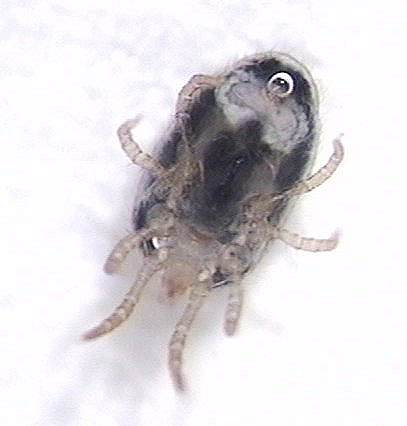
They always have and always had snake mite (Ophionyssus natricis). For the visitors of the zoo it is visible on the albino specimen. The people who have to take care of the snakes know that they all suffer from this parasite. Some efforts have been made to end this parasitic invasion, but this never is successful. On the floor of the terrarium lays a kind of Novilon carpeting. Easy to clean, but it is damaged on several spots. The mites can hide there. There are also many other spots in the terrarium where mites can hide. These mites weaken the snakes because they feed on their blood!

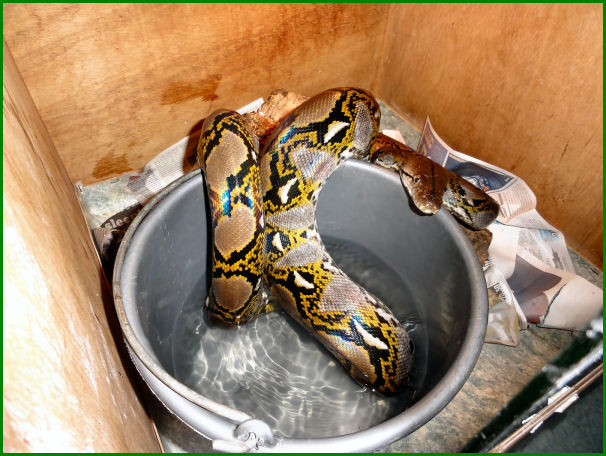
Burmese python with pneumonia. Look at the mucus that comes
out of her trachea

Snake mite (Ophionyssus natricis)
photo: Kalle Berglof, Sweden
The picture is borrowed from
This site


Burmese python with pneumonia. Animal has difficulty breathing


 Also the Burmese Pythons in the zoo often suffer from respiratory problems, especially in the wintermonths. The terrarium is too cold in this period. This problem is easy to solve, but costs money (heating costs).
Lots of Burmese pythons died in this terrarium.

Burmese python with pneumonia. Lots of mucus in her mouth.

donderdag 26 januari 2012

Rattlesnakes Roundup ends in Claxton


Roundup ends in Claxton

CLAXTON -- In its 45th year, the festival formerly known as the Claxton Rattlesnake Roundup is undergoing something of a midlife transformation.

The Evans County Wildlife Club, which has played host to the event since 1968, recently announced that the Annual Claxton Rattlesnake and Wildlife Festival is set for March 10-11. Fully owning its heritage but dropping the word "roundup," the event no longer will include the buying and selling of snakes for competition and prizes.


Crotalus adamanteus
A group of four wildlife and environmental groups that lobbied for years to stop the roundup aspect of the event praised festival officials for their decision.

"We're so happy the rattlesnake roundup in Claxton is being switched to a humane event that celebrates these great native animals and recognizes the importance of saving them," said Collette Adkins Giese, an attorney at the Center for Biological Diversity — a group that works to protect rare and vanishing reptiles and amphibians.

All other elements of the festival — a parade, a pageant, a footrace, a two-day arts and crafts show, live musical entertainment — would be retained, said Wildlife Club President Bruce Purcell. He emphasized that rattlesnakes and snakes of other species still would be exhibited live.

"We want to shift gears from a rattlesnake roundup where everybody came to see rattlesnakes to a wildlife festival where we're promoting wildlife and educating people about wildlife and the conservation of wildlife," Purcell said. "I think we can open this event up and the possibilities for our promoting and protecting wildlife are endless."

Other attractions that enhance the festival as a venue for wildlife education are being expanded, Purcell said. Among these are flight shows featuring bald eagles and other birds of prey from Georgia Southern University's Wildlife Education Center, "Let's Get Wild" shows put on by independent wildlife educator Steve Scruggs, and the Southeast Spring Classic Turkey Calling Contest, sanctioned by the National Wild Turkey Federation annually in conjunction with the festival.

Additionally, new exhibits of snakes, fish and other wildlife are being developed in cooperation with the Georgia Department of Natural Resources (DNR).

But Purcell said rattlesnakes would remain the stars of the show.

Last year, just seven hunters brought in about 100 snakes, Purcell said. The snakes were sold to an out-of-state buyer. With this element of the festival eliminated, Purcell said, eastern diamondback rattlesnakes instead would be exhibited in about equal numbers through exhibits obtained in cooperation with the DNR.

"As far as the public is concerned, we'll still have plenty of snakes to come look at. We're going to have rattlesnakes," Purcell said. "We simply have stopped buying and selling snakes."

The rattlesnake roundup began in 1968. Due to snake hunters dwindling and a move toward wildlife education and conservation, the Wildlife Club board unanimously voted to drop the buying and selling of rattlesnakes.


"We're not in a position to make them go one way or the other, but we certainly support the direction they're going," said DNR Commissioner Mark Williams. "We think it's a good thing, and we're going to help them out any way we can."

Steve Hein, director of the Center for Wildlife Education at Georgia Southern University, also expressed support for the Rattlesnake & Wildlife Festival's new direction. Last year, for the first time, Hein and other staff members brought flight shows of the bald eagle named Freedom and other birds to the festival auditorium.

"I applaud the Evans County Wildlife Club," Hein said. "I will point out that in their (club) constitution, conservation and education have always been the mainstays, so this is not a fundamental shift in philosophy, but rather in practice."

He said Freedom and other birds from the university's collection would be back this year.


Crotalus adamanteus


The festival will maintain a stance friendly to lawful hunting and fishing as essential for wildlife conservation, Purcell said. Organizers, he added, hope to reach out to other groups such as the Ogeechee Riverkeeper and the Georgia Wildlife Federation to augment the exhibits.

The festival is the largest annual event for Claxton and Evans County. Last year's festival drew about 18,000 people, and Purcell said he hopes this year's will top 20,000. The club contributes proceeds to various charities, funds scholarships for local high school students, and makes its building, pavilions and grounds available for other community events throughout the year.

woensdag 25 januari 2012

Experts to check on anacondas' health


The four green anacondas-two males and two females-are doing fine and are kept under observation. They are normal and doing fine, said zoo authorities on Sunday, a day after a female green anaconda died due to heart failure. The zoo has contacted Dr Vasanth Shetty, dean of the veterinary college, who is a member of the zoo health committee, to conduct ultra-sonographic examination. He is likely to come here this week, the zoo authorities said. The authorities believe that there is nothing abnormal about the four surviving anacondas given that they are active and their food intake is normal. 


Mysore zoo is trying to simulate the conditions of an Amazon rainforest in a 40 ft X 20 ft area to house the five anacondas, received as gift from Sri Lanka National Zoo in Colombo.


Dr Suresh Kumar, the veterinarian attached to the zoo told The Times of India that the anaconda that died was a weakling when it arrived, but the Sri Lankan zoo authorities had told them that it would survive. While the other four anacondas have gained a minimum of 40 grams since their arrival from Sri Lanka in November-end, the one that died actually lost weight. "We contacted reptile experts and Sri Lanka zoo authorities while we focused on it. But it died due to heart failure owing to traumatic injury to heart during blood collection. Experts suggested that it is very rare," he stated. 


The Chamarajendra Zoological Gardens, popularly known as the Mysore Zoo, will become the first zoo in the country to house green anacondas from Tuesday.
The public and lakhs of tourists visiting the zoo can have a look at the world’s largest snake from next week. Anacondas can grow up to 20 ft in captivity.
Five medium-size anacondas, including two male, will arrive in Chennai on a cargo flight from Sri Lanka on Tuesday morning. The Mysore zoo authorities will bring them here by road. National Zoological Gardens of Sri Lanka in Dehiwala had gifted five green anacondas as a goodwill gesture last year.
Executive director of Mysore zoo, K. Ravi, told DC that the anacondas will be a prized possession, and the zoo would be happy to give its visitors something new and rare to see. He added, “For the first time, people will get a chance to have a glimpse of the giant snakes in real life.”
The official said that special enclosures are getting ready, and for the time being space has been created in one of the existing enclosures.
“The zoo already has a range of snake species like reticulated python, whose characteristics are similar to anaconda, and cobras. However, special arrangements are being made to create an artificial environment that mimics their natural habitat. Anacondas require temperatures around 27 degrees, and a good amount of space,” Ravi revealed.
It is learnt that the Sri Lankan government has also decided to gift anacondas to the Ahmedabad Zoo, and the consignment will also land in Chennai on Tuesday.
Karnataka Zoo Authority chairman, N. Nanjundaswamy, who visited Sri Lanka to finalise the deal, said proudly that it is a milestone in the history of the zoo.


It is routine to draw blood when the animals are shipped. Otherwise they will not be allowed to be transported. Normally blood is drawn from veins but for reptiles it is difficult to be locate veins and hence it is drawn from the heart, he explained. According to him, the four anacondas from which blood is drawn from the heart don't have any problem. "But we will subject them to ultra-sonographic examination to be sure," he stated.  


The authorities said it requires some 10 minutes for each of the reptile to be diagnosed and they won't be shifted to the zoo hospital but will be examined at their enclosure. It is a simple procedure, they stated.

The zoo officials ruled out that severe cold conditions in the city for the illness of the anaconda that died. Even when the city recorded below 8 degrees Celsius temperature, which is lowest minimum in over a century, the temperature at their enclosure was maintained over 22 degrees Celsius. The heater was kept on round the clock, they stated.


Changes proposed to endangered, threatened species list; New data, tools help update status of rare species in Wisconsin


Contact(s): Kurt Thiede, Land Division administrator,(608) 266-5833 

MADISON - Sixteen birds, plants and other animals are proposed to be removed from the state's list of endangered or threatened species as the result of a comprehensive scientific review of rare species in Wisconsin, according to state endangered species officials.
They are now starting on the administrative rule-making steps required to make the proposed changes. Information on those proposed changes, process followed, and public comment opportunities are available on the Endangered Resources pages of the Department of Natural Resources website.
Some of the 16 species proposed for removal responded well to protections given to listed species and management efforts to increase their populations, while others were found to not be as rare as once thought or no longer occur in the state.

Thamnophis radix - Plains Garter Snake


At the same time, eight different species found during the review to be in jeopardy now or in the near future are proposed to be added to the list, a status that would make it illegal under Wisconsin's Endangered Species Law for people to kill, transport, possess, process or sell them.
"Extensive review of field data from scientists and citizen monitors, DNA analysis, and new mapping technologies have given us an unprecedented understanding of Wisconsin's natural heritage," said Laurie Osterndorf, who directs DNR's Endangered Resources Bureau.
"We're proposing to update our list to accurately reflect this information, recognizing Wisconsin's success in restoring some rare species while giving others the protections they need to survive in the 21st century."
Wisconsin's Endangered Species Law requires DNR to review and, following public input, revise its list of endangered or threatened species. Since the first list was developed in 1972, it has been revised 10 times, most recently in 2011 to add cave bats due to the imminent threat of white-nose syndrome.
State endangered resources staff and outside taxonomy experts have been reviewing information to update the list since January 2010, and are now starting on the administrative rule-making steps required to make the changes.
The steps needed before revisions can be made to the list have changed as a result of Act 21, a law passed earlier this year that required an economic impact analysis be developed in consultation with those who may be affected, along with a more lengthy legislative review process.
Earlier this week, Gov. Scott Walker approved DNR's scope of the rule, which relates to the policy, purpose and objectives of the rule. DNR will go to the Natural Resources Board in early 2012 to seek approval of the scope statement, followed by seeking board authorization to collect public comment to go into the economic impact analysis required of the rule. After that analysis is done, DNR would seek board authorization to conduct public hearings on the rule specifics.
People interested in following the process can get electronic updates by visiting the Endangered Resources web page and selecting "Subscribe to E/T Updates."
Current list changes reflect new field studies, modeling, genetic analysis The current review and revision effort started in January 2010 with DNR's endangered resources staff reviewing scientific data for 3,000 plants and animals. Staff recommended 331 species for full, comprehensive status reviews, Osterndorf said. Biologists from a variety of state and federal agencies, organizations, and universities, as well as naturalists throughout the state with taxonomic expertise provided new or updated information on the population condition and distribution of rare species in the state.

Emydoidea blandingii - Blanding's turtle

"This is the most comprehensive review ever conducted by the department of the status of Wisconsin’s plants and animals," said Kurt Thiede, who leads DNR's Land Division, which includes the endangered resources program. "The program has made strides to create a more transparent list review process and has developed specific scientific guidelines governing how current research is applied to decision-making,"
DNR submitted information along with all current scientific research for each species, and made its proposed revisions. Charts with photos showing the species proposed for addition to or removal from the list are available online, along with the reason for the listing decision, Osterndorf said.
The 16 species proposed to be removed from the list are the greater redhorse, a small fish; the barn owl, snowy egret, and Bewick's Wren, the Pygmy Snaketail, a dragonfly, and two reptiles. The Blanding's Turtle review determined there are large, stable populations and wide distribution. In the case of Butler's Gartersnake, new information indicated greater abundance and range than previously believed. “Genetic analysis done by UW-Stevens Point researchers concluded that hybridization is not a threat to the species,” Osterndorf said.
The remaining species proposed to be removed from the list are plants: the American fever-few, bog bluegrass, Canada horse-balm, drooping sedge, hemlock Parsley, prairie Indian-Plantain, snowy campion, yellow gentian, and Yellow Giant Hyssop. These species are proposed to be delisted for one or more of the following reasons: determination that populations are stable or increasing; new information about the populations; a positive response to protection and management efforts; and/or determination the plant no longer exists in Wisconsin.
Species being recommended for listing to protect declining populations include three birds -- the Black Tern, Kirtland's Warbler, Upland Sandpiper; and four invertebrates -- the beach-dune tiger beetle, ottoe skipper, a leafhopper, an Issid planthopper, and fawnsfoot mussel.
Wisconsin has been a leader in protecting and restoring endangered species, and in fact passed the nation's first endangered species law in 1972, preceding the federal law. Among those endangered species whose populations have recovered in Wisconsin to the degree they have been removed from the list include bald eagles, which were removed from the list in 1997, gray wolves in 2004, osprey in 2009, and trumpeter swans in 2009.

maandag 23 januari 2012

Myanmar officials seize 10,000 snakes that were to be smuggled to China


By Associated Press.

YANGON, Myanmar — Forestry officials in central Myanmar have seized nearly 10,000 snakes in 400 crates that were to be smuggled to China.
The weekly journal Modern reported Friday that 50 cobras were among the 9,176 snakes seized in Pyin Oo Lwin district near Mandalay on Jan. 12.


The report did not say how many people were arrested but said those involved would be charged under the Protection of Wildlife and Conservation of Natural Areas law, which carries a five-year prison sentence.
It said the 7,000 non-poisonous snakes were released into a wildlife reserve, while the vipers and cobras were sent to the state pharmaceutical company for their venom.
Copyright 2012 The Associated Press. All rights reserved. This material may not be published, broadcast, rewritten or redistributed.

vrijdag 13 januari 2012

Close call for alligator egg raiders at Australian Reptile Park


 Richard Noone, The Daily Telegraph. 
 January 13, 2012

The arrival of a large territorial male kept keepers on their toes during the annual alligator egg raid this morning. 
 
The Australian Reptile Park's oldest American alligator, weighing more than 200kg, had been defending a nesting site along with an angry mother and had attacked keepers in a boat earlier in the week.

"It's unusual for males to defend the nest," operations manager Tim Faulkner said.
"Brad and I were in a boat a few days ago inspecting the nests when he came over and had a go at the boat.

Close call ... Reptile keepers Brad Gabriel (R) 
and Chris Wallace (C) try to control American alligator 
´Mr Skinny' while alligator eggs are collected from a nearby nest 
at the Australian Reptile Park north of Sydney 
on January 13, 2012. 
AFP PHOTO / Torsten BLACKWOOD Source: AFP


"He's never done that before."
Keepers have to harvest the eggs laid by several mature females every year to prevent any hatchlings escaping the park at Somersby, north of Sydney, and entering local waterways.
Mr Faulkner said it was also to prevent the harsh Australian sun from overheating and killing the eggs.
Only a handful of eggs are later incubated by the park based on requests from other zoos around the country.
The rest are sent to universities and museums for research.

Egg hunt ... Reptile keeper Tim Faulkner (R) collects American alligator eggs as Billy Collett (2nd R), John Mostyn (2nd L) and Karla Pound (L) try to control 'Big Mumma' at the Australian Reptile Park. AFP PHOTO / Torsten BLACKWOOD Source: AFP


"These eggs were laid either last night or the night before," Mr Faulkner said.
"It's critical that we get in there straight away to remove the eggs because the Australian sun is too hot and once it hits that nest they overheat and actually die rather than incubate."
In a dramatic operation that staff said was as dangerous as anything they do at the park, which also houses collections of Australia's most deadly snakes and spiders, Mr Faulkner lured the mother far enough away from the nest for three other keepers to jump on its back.
Two more keepers had to jump on the large male when it crept out of the water and came close to charging.
 
His top jaw was tied to a tree "otherwise he'd just stand up and carry the keepers off into the water" Mr Faulkner said.
"We can tell when the females have laid their eggs because there's an instant change in behaviour from a gator that sits in the water to what all crocodilians do and that is defend that nest with their life," he said.
Australian Reptile Park
"This year's harvest has been a few weeks later than any we've ever experienced and we believe that was just because we had a very cold, wet start to summer and alligators being reptiles require that beautiful warm sun to warm up to cook their eggs and incubate their eggs."
Keepers collected 45 eggs, which is about an average clutch in the wild but a good sign for a female in captivity.


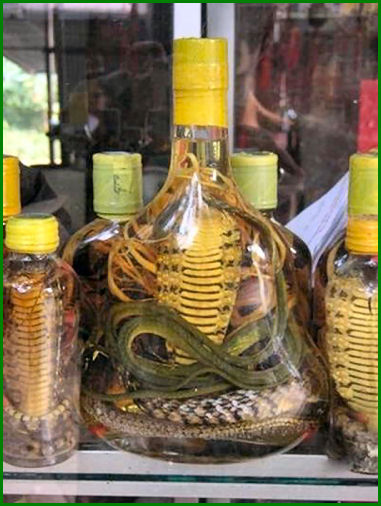
Snake wine


Snake wine – for someone literal interpretation of the “green dragon”. Is an alcoholic beverage, a feature which is a poisonous snake in the bottle. Snake wine originated in Vietnam. And from there spread throughout Southeast Asia. Peak is a popular drink in Japan reached.


They say if the snake wine has healing properties, cures everything and full of happiness, increased sexual activity. Of course, all this should be seen as a joke. All of this invented sly marketers to attract customers.

However, foreign lovers of thrills and spirits like to visit the snake restaurants. After import snake wine is banned in many countries. For the reason that used for its production of cobra and other rare endangered species of snakes.

Snake as the main ingredient of this wine is usually not appreciated because of their meat, but because of the snake venom, dissolved in alcohol. 
It is thought the wine is better than the snake is poisonous. However, the poison should not be afraid. Snake venom is protein based and deactivated under the influence of alcohol.

This drink is prepared in this way: take a large poisonous snake placed in a glass jar of rice, with many small snakes, turtles, birds, insects (specific set depends on the mood of the winemaker) and left to ferment for several months. The wine then drink small sips or small cups.


donderdag 12 januari 2012

Animal cruelty, part 6

A reminder why I place these articles!

The manager of the largest reptile zoo in the Netherlands has often said in public (television, newspapers, etc) that private keepers of reptiles, amphibians and invertebrates do not take care of their animals in the right way. He wants stronger laws and a mandatory animal-registration. He thinks he is holier than the Pope because a number of animals which are his responsibility are mistreated in a terrible way. Often this are animals that were confiscated by the government of the Netherlands. They are the property of the Dutch government and the zoo gets payed well to take care of them.

Also take a look at: 

----------------------------------------------------------------------------------------------------

In the basement of the reptilezoo there live some Blue-tongued skinks (Tiliqua scincoides).
Every year there are a number of young born in this terrarium. Other zoos have no intrest in these young and this means that they have to live for a long period (sometimes for years) in the quarantine of the reptilezoo. This would not be that bad when these animals had a decent terrarium to live in.
But, this is not the case. These animals have to live in plastic boxes with the following measurements: 30 x 20 x 15 cm (BxDxH).

Tiliqua scincoides: no room to move for a long period! What you see is all the room they have!

There is no additional heating or illumination present except that the boxes get some light from a small window. Temperature in the boxes is "roomtemperature" which is in this case 24 degrees Celsius.
It is obvious that these animals barely have room to move.  Next to that is their main food catfood. No good circumstances for animals that easily get to fat.
The last time I saw the young in the plastic boxes were between 25 and 30 cm long!
All this animal cruelty could be prevented when they remove the male from the females in the exhibition-terrarium in the basement.


The plastic boxes in which they have to live